
Which Science Degree Is Best for Future? A Complete Guide for Students and Parents
Choosing a university degree is one of the most important decisions a student will ever make. With rapid technological advancements, climate challenges, healthcare innovation, and artificial intelligence transforming the world, many students and parents are asking a critical question: which science degree is best for future careers?
Science degrees have always been associated with innovation, stability, and global relevance. However, not all science degrees offer the same career growth, job security, or earning potential in the future. Some fields are expanding rapidly, while others are evolving or becoming more specialized.
This in-depth guide explores which science degree is best for future success, considering job demand, salary prospects, global relevance, and long-term career stability. Whether you are a high school student, a university applicant, or a parent guiding your child, this article will help you make an informed decision.
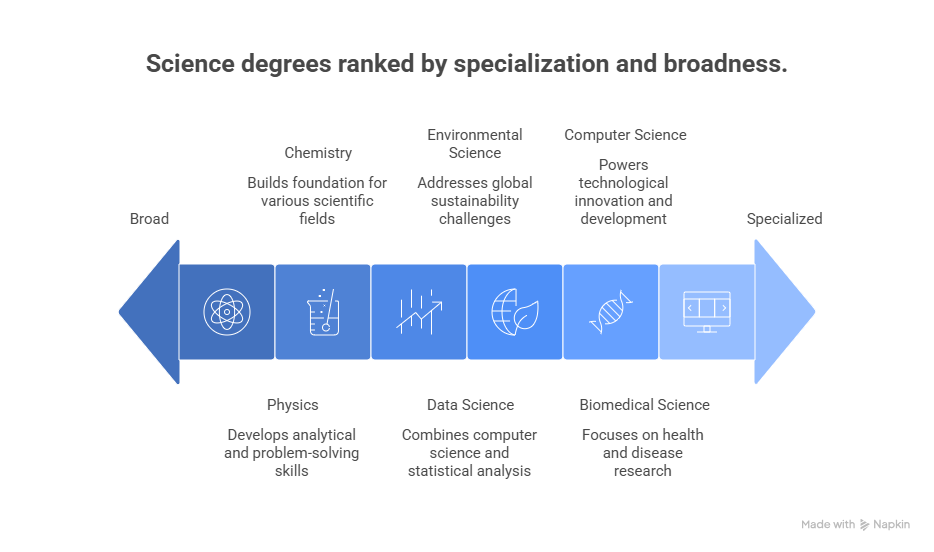
Why Choosing the Right Science Degree Matters for the Future
The future job market is changing faster than ever before. Automation, artificial intelligence, biotechnology, renewable energy, and data-driven decision-making are redefining how industries operate.
A science degree is no longer just about studying theories or working in a lab. Today’s science graduates work in industries such as:
-
Technology and software development
-
Healthcare and medical research
-
Environmental sustainability
-
Space exploration
-
Artificial intelligence and robotics
-
Data science and analytics
Choosing the right science degree can determine:
-
Your employability after graduation
-
Your salary potential
-
Your ability to work globally
-
Your career flexibility over decades
That is why understanding which science degree is best for future opportunities is essential.
Key Factors to Consider When Choosing a Future-Proof Science Degree
Before diving into specific degrees, it is important to understand what makes a science degree valuable for the future.
1. Job Market Demand
A future-ready science degree should align with industries experiencing long-term growth rather than short-term trends.
2. Technological Integration
Degrees that integrate technology, programming, data analysis, or automation tend to offer stronger career prospects.
3. Global Relevance
Some science degrees offer international opportunities and are in demand across multiple countries.
4. Interdisciplinary Flexibility
Degrees that allow graduates to work across different industries provide better career security.
5. Research and Innovation Potential
Fields that drive innovation often receive more funding and offer higher growth potential.
Which Science Degree Is Best for Future Careers?
Below is a detailed breakdown of the best science degrees for the future, based on global trends, employment data, and industry forecasts.
1. Computer Science and Artificial Intelligence
When people ask which science degree is best for future, computer science consistently ranks at the top.
Why Computer Science Is Future-Proof
-
Technology is integrated into every industry
-
AI and automation are expanding rapidly
-
High demand for skilled professionals
-
Excellent salary potential
Career Options
-
Software Engineer
-
Data Scientist
-
AI Engineer
-
Cybersecurity Analyst
-
Machine Learning Specialist
Future Outlook
Artificial intelligence, cloud computing, and automation are expected to grow for decades. Computer science graduates can work in healthcare, finance, education, entertainment, and government sectors.
2. Data Science and Analytics
Data is often called “the new oil.” Organizations rely on data to make decisions, predict trends, and improve efficiency.
Why Data Science Is One of the Best Science Degrees for the Future
-
Massive demand across industries
-
Combines mathematics, statistics, and programming
-
Strong global job market
Career Options
-
Data Analyst
-
Data Scientist
-
Business Intelligence Analyst
-
Quantitative Researcher
Future Outlook
As data generation continues to grow, professionals who can analyze and interpret data will remain in high demand.
3. Biomedical Science and Biotechnology
Healthcare and life sciences are evolving rapidly due to aging populations, genetic research, and medical innovation.
Why Biomedical Science Is Future-Ready
-
Growing healthcare needs worldwide
-
Advances in genetics and personalized medicine
-
Strong research and development funding
Career Options
-
Biomedical Researcher
-
Clinical Scientist
-
Biotechnology Specialist
-
Pharmaceutical Researcher
Future Outlook
Biotechnology plays a key role in disease prevention, treatment, and medical innovation, making it one of the most stable science fields.
4. Environmental Science and Sustainability
Climate change and environmental protection are global priorities. Governments and organizations are investing heavily in sustainability.
Why Environmental Science Is One of the Best Science Degrees for the Future
-
Rising demand for sustainability experts
-
Strong government and private sector support
-
Meaningful impact on the planet
Career Options
-
Environmental Scientist
-
Climate Analyst
-
Sustainability Consultant
-
Conservation Specialist
Future Outlook
Environmental science graduates will be crucial in addressing climate change, renewable energy, and resource management.
5. Renewable Energy and Energy Science
The global shift away from fossil fuels has created massive demand for renewable energy experts.
Why Energy Science Is a Smart Future Choice
-
Rapid expansion of solar, wind, and hydrogen energy
-
Government investments worldwide
-
Strong engineering and science overlap
Career Options
-
Renewable Energy Scientist
-
Energy Analyst
-
Solar or Wind Energy Specialist
Future Outlook
Clean energy will dominate future infrastructure, making this field highly secure.
6. Physics and Applied Physics
Physics is a foundational science that supports many advanced technologies.
Why Physics Still Matters for the Future
-
Strong analytical and problem-solving skills
-
Applications in technology, engineering, and research
-
High adaptability across industries
Career Options
-
Research Scientist
-
Aerospace Analyst
-
Materials Scientist
-
Data or Quantitative Analyst
Future Outlook
Graduates with applied physics skills often transition into high-tech and research-driven roles.
7. Chemistry and Materials Science
Chemistry remains central to pharmaceuticals, materials development, and industrial innovation.
Why Chemistry Is a Strong Future Degree
-
Used in healthcare, energy, and manufacturing
-
Critical for materials science and nanotechnology
Career Options
-
Chemical Researcher
-
Materials Scientist
-
Pharmaceutical Chemist
Future Outlook
Specialized chemistry fields will continue to grow, especially in medical and industrial research.
Comparing Science Degrees: Which One Is Best for You?
When deciding which science degree is best for future success, consider your personal interests alongside job prospects.
| Interest Area | Best Science Degree |
|---|---|
| Technology & Coding | Computer Science |
| Numbers & Patterns | Data Science |
| Medicine & Health | Biomedical Science |
| Environment & Climate | Environmental Science |
| Energy & Engineering | Renewable Energy Science |
| Research & Theory | Physics |
| Materials & Chemicals | Chemistry |
Skills That Make Any Science Degree Future-Proof
Regardless of which science degree you choose, developing the following skills will increase your employability:
-
Programming and data analysis
-
Critical thinking and problem-solving
-
Communication and teamwork
-
Research and analytical writing
-
Adaptability and lifelong learning
FAQs: Which Science Degree Is Best for Future?
1. Which science degree is best for future job security?
Computer science, data science, and healthcare-related degrees offer the strongest job security due to continuous demand.
2. Which science degree has the highest salary potential?
Computer science, artificial intelligence, and data science generally offer the highest salaries globally.
3. Is a pure science degree better than applied science for the future?
Applied science degrees often provide faster employment, but pure science degrees offer strong long-term research and academic opportunities.
4. Which science degree is best for students who want to work abroad?
Computer science, data science, and biomedical science have high international demand.
5. Is environmental science a good degree for the future?
Yes. With global climate challenges, environmental science is becoming increasingly important and future-focused.
6. Can one science degree lead to multiple career paths?
Yes. Degrees like physics, computer science, and data science are highly flexible and transferable across industries.
Final Thoughts: Which Science Degree Is Best for Future Success?
Choosing a science degree is not just about selecting a subject to study for a few years; it is about shaping your long-term career, financial stability, and ability to adapt in a rapidly changing world. As technology, healthcare, energy, and environmental priorities continue to evolve, students and parents alike are right to ask which science degree is best for future success.
The reality is that the “best” science degree does not exist in isolation. Instead, the most valuable degree is one that sits at the intersection of personal interest, market demand, and future relevance. Degrees such as computer science, data science, biomedical science, and environmental science consistently stand out because they align with global needs and long-term industry growth. These fields are not driven by short-lived trends; they are powered by fundamental changes in how society operates, heals, communicates, and sustains itself.
Another critical factor to consider is flexibility. Future careers are unlikely to follow a straight path. Many professionals will change roles, industries, or even entire career directions multiple times. Science degrees that emphasize transferable skills—such as analytical thinking, problem-solving, data interpretation, and research—offer graduates the freedom to pivot when new opportunities arise. This is why degrees like physics, chemistry, and data science continue to remain relevant despite shifts in specific job titles or technologies.
It is also important to understand that a science degree alone is not enough. The future belongs to learners who continuously upgrade their skills. Regardless of which science degree you choose, developing complementary skills such as programming, communication, teamwork, and digital literacy will significantly increase your employability. Internships, research projects, certifications, and real-world experience can often be just as valuable as the degree itself.
For students who are unsure about committing to a highly specialized path, broad science degrees with applied components can be an excellent starting point. They allow exploration while still building a strong foundation for future specialization. On the other hand, students with a clear passion—whether it is artificial intelligence, medical research, or environmental protection—can benefit greatly from choosing a focused degree aligned with that goal.
Ultimately, when asking which science degree is best for future opportunities, the answer lies in balance. Choose a field that excites your curiosity, matches your strengths, and aligns with global trends. A degree that motivates you to learn, grow, and innovate will always outperform one chosen solely for salary or prestige.
The future will continue to reward problem-solvers, innovators, and critical thinkers. With the right science degree and a commitment to lifelong learning, students can confidently prepare for careers that are not only secure and well-paying but also meaningful and impactful in shaping the world of tomorrow.